Event 1
Bella Baxter’s creation
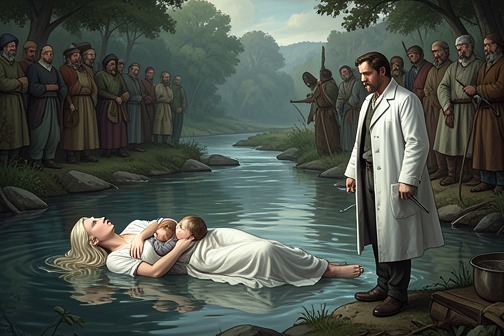
[Bella Baxter’s creation](entity:event-recall-event-bella-baxter-s-creation-59f1b1c966b8) is the concealed act at the center of her extraordinary origin: [Godwin Baxter](entity:character-recall-character-godwin-baxter-b068fb3f37e6) preserves the body of a woman who drowned in the [River Clyde](entity:location-recall-location-river-clyde-277d0df2a626) and joins it to the thinking part of her unborn child. The revelation turns what first appears to be an inexplicable new life into a deliberate medical experiment, rooted not only in Baxter’s research but in the social disposal of the poor, the dead, and those whose lives institutions cannot accommodate.
## The drowned woman
A contemporary record dates the recovery of an unidentified pregnant woman’s body from the Clyde to 18 February 1881. Godwin Baxter, acting as police surgeon, certified death by drowning. The record describes a woman about twenty-five years old, five feet ten and three-quarter inches tall, with dark brown curling hair, blue eyes, a fair complexion, and hands unused to rough work. She was well dressed, but nobody claimed her body after it was advertised.
Baxter’s later account supplies the circumstances behind that official description. [George Geddes](entity:character-recall-character-george-geddes-5737c851d611) worked for the [Glasgow Humane Society](entity:organization-recall-organization-glasgow-humane-s-93bba6617157), lived rent-free on [Glasgow Green](entity:location-recall-location-glasgow-green-271ae7481b11), and was responsible for recovering bodies from the river and saving people when possible. Bodies that could not be revived were kept in a small morgue attached to his dwelling for examination by a police surgeon; when the surgeon was unavailable, Geddes called Baxter. Bodies left unclaimed could pass from the morgue to dissecting rooms and laboratories, a transfer Baxter had arranged before.
Geddes saw the young woman climb onto the parapet of the suspension bridge near his home. Unlike people who entered the water feet first, she dived like a swimmer, but exhaled rather than drawing breath; she did not surface alive. A reticule strap had been tied to her wrist, and the bag was filled with stones. The deliberate preparation suggested to Baxter a wish not merely to die but to remain unidentified. Her fashionable clothes had empty pockets, with neat holes cut into the linings and into the places in her lingerie where wealthier women might have their names or initials sewn. Pressure grooves on a finger showed that wedding and engagement rings had been removed. Baxter found her pregnant, and [Archibald McCandless](entity:character-recall-character-archibald-mccandles-67aa881c98c2) inferred that the child might have belonged either to a husband she hated or to a lover who had abandoned her. The account establishes the clues, not which possibility was true.
## Baxter’s decision
The body was still fresh when Baxter examined it: rigor mortis had not set in, and it had hardly cooled. He cleared water from the woman’s lungs and removed the fetus from her womb. He believed that electrical stimulation could have brought the woman herself back to conscious life, but chose not to do so. In his reasoning, the woman had rejected her life so completely that revival might force her into institutions that treated suicide as lunacy or crime: madhouses, reformatories, or jails. Instead, he kept her body alive at a purely cellular level. When the body remained unclaimed, he took it to his father’s laboratory.
Baxter describes this decision against a wider account of death and medical neglect. He says that hundreds of young women drowned themselves each year under the pressure of poverty and prejudice. He also points to infants born with severe conditions that meant they could not survive without artificial help, or could not survive at all. Some, he says, had no digestive tract and would starve after the umbilical cord was cut unless someone acted first. Doctors could not openly perform or order such acts, though Baxter says they happened; meanwhile, poor parents in [Glasgow](entity:location-recall-location-glasgow-50d067f692a1), a city he identifies with exceptionally high infant mortality, might not be able to afford a coffin, funeral, and grave for each dead child. Even unchristened infants, he observes, were consigned by Catholics to limbo. He calls the medical profession the practical destination of that limbo: the place where abandoned bodies and lives accumulated.
## The making of Bella
Baxter says that he had spent years planning to unite a discarded body with a discarded brain drawn from this social and medical remainder. In this case, he used the thinking part of the fetus already carried by the woman. When Archibald McCandless later asked whether Baxter could have saved the child, Baxter answered that he had saved its thinking part and that the woman’s body had already contained a compatible brain. Bella’s creation therefore depends on a transfer between lives rather than the return of the drowned woman’s former consciousness. Baxter links the new person to the surviving body, but identifies the child’s thinking part as the basis of the life he made.
The method also gives the story’s apparent miracle a material and institutional history. The river supplies a body; the reticule’s stones and the removed rings mark an attempt to disappear; the unclaimed corpse moves through a morgue and into a laboratory; and Baxter’s electrical and surgical knowledge makes a new life possible. Neither the body nor the fetus is treated as an abstract symbol in his account: each has been exposed to the practical systems that determine which lives are rescued, mourned, hidden, or put to use. Baxter’s experiment reverses the usual passage from the morgue to dissection by turning remains into the conditions of a new person.
## Revelation and significance
Baxter tells Archibald McCandless about the creation after the events that first brought him into contact with Bella. The account reaches its decisive clarification when McCandless asks how advanced the pregnancy was and whether the child could have been saved. Baxter confirms that it was at least nine months and explains that the child’s thinking part became the basis of Bella. This retrospective disclosure makes the earlier description of Bella asleep newly charged: Baxter recognizes in her resting face the sorrowful woman whose body had lain before him, while also insisting that he did not know the life she had abandoned. Bella’s origin is disclosed, but the drowned woman’s history, name, and reason for removing her rings remain unresolved.
The creation joins scientific ambition to a problem of consent and responsibility. Baxter refuses to restore the drowned woman to consciousness because he imagines the institutional suffering that might follow, yet he preserves her body for an experiment she could not authorize. His act offers neither a simple rescue nor a simple return: it prevents the body from becoming only an unclaimed corpse, but creates a person through a medical decision made on behalf of two lives. Bella’s beginning thus bears the marks of both material possibility and social failure. The life Baxter makes is inseparable from the prior death, the child whose thinking part he saves, and the unequal conditions that left both without ordinary protection.
Event 2
Bella Baxter’s European elopement
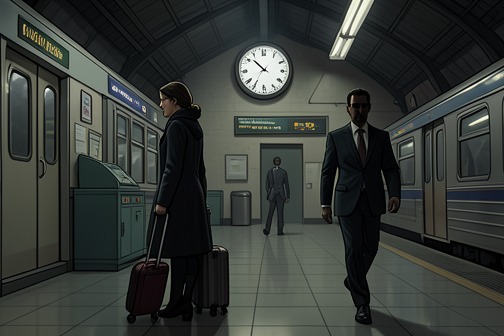
[Bella Baxter’s European elopement](entity:event-recall-event-bella-baxter-s-european-5fccc6fc013e) with [Duncan Wedderburn](entity:character-recall-character-duncan-wedderburn-efec926ab64a) turns a wedding journey into a contest over money, dependence, and freedom. As Duncan’s gambling repeatedly strips him of cash and self-command, Bella moves from improvising ways to keep the trip going to deliberately ending it: she leaves him in [Paris](entity:location-recall-location-paris-c02b439ce220) with the money she has saved and chooses to support herself by working. The episode’s shifts in power are practical as well as emotional, measured in tickets, hotel bills, hidden banknotes, and the journeys Bella arranges while Duncan is unable to act independently.
## The gambling crisis and the journey east
After Duncan returns to their hotel penniless, Bella tells him that the five hundred he had bet her will allow them to continue their wedding trip the next day, and promises to return it. At the station he buys tickets to Switzerland, then leaves Bella with their luggage in the ladies’ waiting-room, saying he will smoke a cigar. Instead, he slips into a betting shop for another attempt to recover his losses and loses everything. He comes back in a state of agitation that Bella describes through the image of Hamlet over Ophelia’s coffin.
Bella decides that reassurance will not quiet him; she performs distress of her own, answering his panic with a hollow assurance that she will find money. She sends him to wait while she takes two hours for herself, then returns in time for the later train. During the next four days she refuses to explain their destination, repeating [“Never ask!”](entity:expression-recall-expression-never-ask-c88c767d453f) Duncan is physically unwell, has run out of his anti-lethargy pills, and craves more. So dependent that he can go nowhere without Bella leading him by the arm, he can be left in a hotel room while she makes arrangements.
In [Trieste](entity:location-recall-location-d475e87ba5ac), Bella books passage on a Russian vessel of the kind previously recommended as offering fewer gambling facilities and less social distraction. She cannot write its Russian name and records how it sounds as Cut-use-off. As they walk toward the docks in the rain, Duncan stops outside a tobacconist’s and asks whether they are going on a long voyage. His question marks a change in their journey: Bella, rather than Duncan, now controls where they are headed.
## [Odessa](entity:location-recall-location-odessa-7da577344387) and the unequal voyage
The Russian merchant navy carries them to Odessa, where the ship stays for three days to take on a cargo of beetroots. By then Duncan is no longer jealous of Bella going ashore alone. He asks her to return as soon as possible, but permits her to leave without him. The change does not mean that the strain of the journey has disappeared; it shows that his dependence and exhaustion have displaced the possessiveness that had governed their earlier interactions.
The contrast between them persists at sea. Duncan later travels aboard a passenger ship, where he spends afternoons and evenings playing cards with men in the main saloon. On the voyage to [Marseille](entity:location-recall-location-674701579776), he orders wine with meals and insists that a meal without wine is no meal, although Bella drinks none because even a sip makes her giddy. She goes to bed while he continues playing. On the night before they reach Marseille, he returns delighted with his winnings, calls her affectionate pet names, and says that she had been right: games of skill, rather than games of chance, are his métier. He gets into bed the right way round for the first time in weeks. Bella begins to enjoy what he calls their second honeymoon, but recognizes that another reversal is coming; he falls asleep, while she remains awake, knowing she cannot prevent it.
## Marseille: winnings lost again
Rather than travel directly from Marseille to Paris, the couple stays at a hotel recommended by one of Duncan’s fellow card players. That acquaintance introduces Duncan to a café, club, or card-school, where Duncan plays every afternoon and evening. Bella waits at the hotel, drinking cup after cup of chocolate and brooding over [An Essay on the Principle of Population](entity:object-recall-object-df12e8499c80). His recent success at cards proves temporary: it takes five days for him to lose everything he has won.
When Duncan comes back to their room, he admits that he is again at Bella’s mercy and asks whether she has enough to pay the hotel. He also says that he is totally cleaned out and assumes that she prefers him in this condition. Bella has no intention of using [Godwin Baxter](entity:character-recall-character-godwin-baxter-b068fb3f37e6)’s money until the last possible moment. Instead, she packs essentials into a handbag, makes herself and Duncan presentable, and takes him for a walk to a railway station. They board an overnight train to Paris.
Duncan tries once or twice to break away and return to the hotel for a dressing-case containing silver-mounted brushes that had belonged to his father. Bella refuses, pointing out that he booked their room and should be glad that the hotel is receiving something valuable in return. Her response treats the brushes not as a reason to turn back but as payment toward an unpaid bill. Relieved to be away from Marseille, Bella sleeps sitting upright on a wooden bench in a third-class carriage.
## Paris and the final separation
In Paris, Bella again finds herself alone with Duncan’s crisis. He blames her for taking five hundred friedrichs d’or, claiming that she broke his run of luck and kept him from winning enough to make their marriage possible. He imagines the money he might have given to charity and the church, as well as the town house in [London](entity:location-recall-location-london-420923d4a60a), Mediterranean yacht, grouse moor in [Scotland](entity:location-recall-location-scotland-4e112aa71aa3), and heavenly mansion that his winnings would supposedly have secured. His speech turns from these lost prospects to a declaration that he wishes to be separated from Bella by a gulf deeper than Hell and feels only hatred for her.
Bella answers by cutting open the lining of her coat and producing Clydesdale and North of Scotland banknotes worth five hundred pounds sterling. She tells Duncan that she had kept the money for the moment when it would be needed and now offers it to him. Her gesture overturns his account of their dependence: the money that can release him is not a recovery of his gambling fortune but the reserve Bella has carried herself. She tells him to return to [Glasgow](entity:location-recall-location-glasgow-50d067f692a1) and be free of her.
Duncan does not accept the offer calmly. He tries to swallow the notes, then attempts to throw himself out of a window; unable to open it, he rushes through the door and tries to dive downstairs head first. [Millie Cronquebil](entity:character-recall-character-millie-cronquebil-df4d6e1c8ab3), who has been listening from the adjoining room, calls her staff. They restrain Duncan and give him brandy. Getting him onto a train to Calais is difficult, but, with the staff’s help, he goes. He does not truly want to leave Bella, even as the separation becomes necessary.
Millie urges Bella to keep most of the five hundred pounds. Bella refuses, saying that Duncan loves money more than she does and that it is his reward for the weddings they have enjoyed. She resolves instead to earn what she needs by working, something she has not done before. The elopement therefore ends not with a restored couple or a renewed promise, but with Bella relinquishing the money and choosing a new source of independence.
## Narrative shape and significance
The episode is recounted in Bella’s letter to Godwin Baxter, and its brisk changes of pace reproduce the instability of the trip. Bella announces that she will tell the rest fast, then recounts a sequence of wagers, delays, improvised journeys, and departures in which the same crisis repeatedly returns: Duncan loses his money, and Bella must decide what to do next. The repeated withholding of their destination, condensed in “Never ask!”, makes travel itself part of her management of his dependence.
The contrast between the two travelers sharpens as the journey proceeds. Duncan treats gambling winnings as the basis for an imagined future of marriage, property, charity, and religious reward; Bella observes his play, arranges their movement, and finally reveals that she has kept money aside. His fortunes rise and collapse at the card table, while her capacity to choose and act grows. The final railway departure converts that difference into an actual separation: Duncan is sent away with the money, and Bella remains committed to earning her living.
Event 3
Great Famine
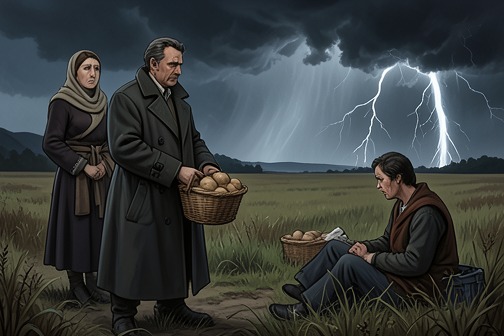
The [Great Famine](entity:event-recall-event-2343ef0f862a) enters the narrative through [Duncan Wedderburn](entity:character-recall-character-duncan-wedderburn-efec926ab64a)’s account to [Bella Baxter](entity:character-recall-character-bella-baxter-25aa9cac7b59): a potato disease brought mass starvation, while landlords, parliamentary policy, and the movement of grain helped determine who suffered and who left. The episode makes a national catastrophe part of Bella’s encounter with the political arguments Wedderburn wants her to understand—and gives her a pointed measure of his own moral courage.
## Causes and Conditions
Wedderburn begins with the dependence of the poor on potatoes: he says that eight out of ten people in [Ireland](entity:location-recall-location-5359e95725af) lived on them, because the peasants’ poor soil grew little else. What money they earned by other means went to rent. In his account, ownership compounded that vulnerability: English-descended landlords held the fertile land on which corn was grown, while the peasants depended on a crop that could fail.
A sudden disease killed the potatoes, and starvation followed. Wedderburn places the disaster thirty-five years before his telling. He does not present the famine as crop failure alone; the unequal distribution of land and the peasants’ limited alternatives form the background to the catastrophe he describes.
## Parliamentary Policy and the Grain
Wedderburn recounts that the [British Parliament](entity:organization-recall-organization-british-parliame-7eeefe71e6e7) considered closing Ireland’s ports so that Irish grain would be eaten by the Irish population. The proposal was rejected because it would interfere with free trade. Instead, soldiers were sent to ensure that grain reached the ships. In his telling, a political commitment to trade took precedence over keeping food in a famine-stricken country.
The scale of the loss gives that decision its force: Wedderburn says nearly a million people starved to death and a million and a half left the country. Those who reached [Britain](entity:location-recall-location-cc30c45755f2), he adds, worked for such low wages that they helped drive down the wages of British workers, while British industries made greater profits. The consequences of the famine therefore extend beyond death and displacement: migration also supplied employers with cheaper labour.
## Bella’s Challenge to Wedderburn
Wedderburn knows that, when his lessons become unbearable, Bella runs to the ship’s stern and leans over the rail, letting the wind carry her cries out to sea. After this account, she does not simply retreat. She asks whether he would have voted against keeping the ports open if he had been a member of Parliament. She tells herself she would not bite him if he answered yes, but would spit in his face.
Wedderburn answers quietly that he would not have dared vote against the proposal had he known he would later have to face her. Bella nearly calls him a cunning fiend, then recognizes that such language belongs to Wedderburn’s own manner of speaking; she swallows her spit and walks away. The exchange leaves his historical lesson unsettled by the question of personal responsibility: describing injustice is not the same as having resisted it.
## Narrative and Political Significance
The famine episode is presented as part of Bella’s diary account of Wedderburn’s teaching, not as an impersonal historical narrative. Its details arrive through his explanation, and Bella’s response tests that explanation against the speaker himself. The movement from political history to a question about how he would have voted makes the scene both an account of mass suffering and a confrontation between the abstract defence of policy and the prospect of being answerable to its victims.
Wedderburn’s account connects famine, free trade, military enforcement, migration, and wages in a single chain of consequences. The scene’s final turn keeps that chain from remaining merely theoretical: Bella asks what he would have done, and his answer exposes the distance between knowing how a system works and daring to oppose it.
Event 4
Napoleonic Wars
The [Napoleonic Wars](entity:event-recall-event-d4e89cd796ba) appear in [Bella Baxter](entity:character-recall-character-bella-baxter-25aa9cac7b59)’s diary through [Godwin Baxter](entity:character-recall-character-godwin-baxter-b068fb3f37e6)’s account of their economic and social consequences for [Britain](entity:location-recall-location-cc30c45755f2). Rather than treating the conflict as a sequence of battles, Baxter presents it as a force that accelerated industrial growth while leaving the poor to bear its taxes, labor demands, and postwar hardships.
## War and Industrial Expansion
Baxter argues that the effort to fight Napoleon across Europe helped establish Britain’s industrial advantage. The government imposed heavier taxes, which fell chiefly on the poor, and spent much of the revenue on continuing supplies of uniforms, boots, guns, and shipping. Those contracts encouraged the building of factories and tied wartime mobilization to industrial production.
With many able-bodied men serving abroad, new machinery enabled factories to operate with the cheap labor of women and children. Baxter presents this combination of mechanization and underpaid labor as a source of increased profits. Those profits, in turn, supported investment in trains and ironclads and the expansion of the [British Empire](entity:organization-recall-organization-british-empire-1ed378e18a0a). In his account, Britain’s later industrial and imperial power was therefore inseparable from the wartime economy that helped finance it.
## The Postwar Crisis
The end of the war did not bring security to the people who had borne its costs. Baxter describes widespread unemployment and hunger, severe enough that a parliamentary committee met to consider the problem and the government feared revolution. The contrast is central to his account: a conflict that strengthened national industry left many people without work or food when military demand subsided.
The socialist factory owner Robert Owen proposed that businesses earning more than five per cent in profit use the surplus to improve workers’ food, housing, and schooling, rather than spend it undercutting competitors. Baxter sets this proposal against the arguments of [Malthusianism](entity:concept-recall-concept-malthusianism-61220ecf779a), which treated improved provision for the poor as likely to increase population. His account exposes how claims about population could be used to resist relief even as poverty, hunger, and disease weakened the people supposedly being discussed.
## Poverty, Discipline, and Social Order
Baxter describes the postwar response not as the removal of poverty but as the construction of institutions to contain it. Military barracks beside industrial cities, a strong police force, and large new jails formed part of the system. So did poorhouses, where children were separated from parents and husbands from wives.
The poorhouses were deliberately made so grim, Baxter says, that people with a remaining sense of self-respect might spend their last pennies on cheap gin and die outdoors rather than enter them. His bitter conclusion is that these arrangements allowed the world’s richest industrial nation to function. The phrase turns prosperity into an indictment: national wealth and industrial success coexist with policies that punish, divide, and abandon the poor.
## Baxter’s Historical Argument
Baxter’s account makes the Napoleonic Wars a lens for examining the distribution of economic benefit and suffering. The state’s wartime purchases fostered factories and profits; mechanized production drew women and children into cheap labor; and the postwar crisis was met with arguments against improving workers’ conditions and institutions that enforced social discipline. The sequence challenges a celebratory story of industrial progress by tracing its costs into ordinary working lives.
The account also belongs to Baxter’s wider effort to teach Bella how social arrangements shape what people consider normal. His explanation links warfare not only to military power but to taxation, labor, industrial investment, and the treatment of poverty. In the diary, the war is thus recalled as a turning point whose effects extended well beyond the battlefield.
Event 5
British bombardment of Alexandria
The [British bombardment of Alexandria](entity:event-recall-event-b281f7224fc4) enters the narrative not as a battle scene but as evidence in an argument about imperial power. Dr. Hooker points to the shelling as [Britain](entity:location-recall-location-cc30c45755f2)’s recent action in [Egypt](entity:location-recall-location-2ea1f28344b7); [Harry Astley](entity:character-recall-character-harry-astley-4472efec3cea) answers by invoking the canal and the threat he says [Alexandria](entity:location-recall-location-fb05bbb5af3c) posed.
## Background and Context
The exchange takes place amid a discussion of Dr. Hooker’s journeys through Central Asia, undertaken after American citizens asked him to report on the region. Hooker contrasts that assignment with Britain’s reach across the world, noting that Britain had taken Egypt from both the French and the Egyptians less than two years earlier. The bombardment is presented within this larger dispute over who claims authority over territories and routes.
## The Attack in the Debate
Hooker brings up the shelling of Alexandria, described as the next port of call on his party’s route. Astley responds that Britain needed the canal and had paid for it; Hooker’s reply makes clear that acquiring or securing the route does not erase the attack on the city. Astley then argues that Alexandria was arming against Britain and again cites the canal as the reason for British action. The conversation offers competing justifications rather than a detailed account of the bombardment itself.
## Imperial Stakes
The surrounding discussion connects the Egyptian episode to British military action in the Sudan, where British regiments are fighting the Dervishes. Astley states that Britain cannot tolerate religions that encourage local people to rule themselves, because home rule would disrupt trade and the operation of the canal. In this argument, the bombardment is part of a wider pattern in which commercial access and imperial control are presented as reasons to resist self-government. Hooker’s challenge exposes the tension between Astley’s language of payment and security and the force used to protect British interests.
Event 6
British occupation of Egypt
The [British occupation of Egypt](entity:event-recall-event-c27237b39f74) is recounted as an imperial act whose practical concern was the canal and whose public justification was the supposed duty to govern and civilize. In a conversation between Dr. Hooker and [Harry Astley](entity:character-recall-character-harry-astley-4472efec3cea), competing explanations expose the tension between strategic self-interest and the language used to excuse British power.
## Causes and Strategic Interests
Dr. Hooker describes [Britain](entity:location-recall-location-cc30c45755f2) as having carved up much of the planet and says that, less than two years earlier, it had taken [Egypt](entity:location-recall-location-2ea1f28344b7) from both [France](entity:location-recall-location-4f282e1af8a7) and the Egyptians. Astley answers that Britain needed the canal and had paid for it. His reply treats payment as an answer to Hooker’s charge, but does not displace the strategic motive that both men place at the centre of the discussion: British control depended on access to the canal.
Hooker also points to the British shelling of [Alexandria](entity:location-recall-location-fb05bbb5af3c), which he identifies as the next port of call. Astley defends the bombardment by saying Alexandria was being armed against Britain and again insists that Britain needed the canal. The exchange links the occupation to armed force as well as commercial strategy: Hooker names the violence, while Astley casts it as a necessary response to a threat.
## Rule, Trade, and Imperial Justification
Hooker makes the political stakes explicit when he says Britain cannot tolerate religions that urge local people to rule themselves. In his account, home rule would disturb trade and the smooth operation of the canal. Self-government is thus represented not as a right but as an obstacle to British commercial and strategic interests.
Astley’s later description of British invasions supplies a contrasting justification. He presents Britain’s invasion of Egypt as policing and civilizing rather than warfare, placing it within a wider claim that Anglo-Saxon expansion will eventually bring peace under Anglo-Saxon law. The language transforms invasion into benevolent administration; set beside Hooker’s account of trade and the canal, it makes the civilizing rationale appear inseparable from the interests it claims to transcend.
## The Event in the Conversation
The occupation enters the scene through argument rather than direct narration of military events. Dr. Hooker challenges the British account, Astley defends it, and the discussion moves between the immediate example of Egypt and broader claims about imperial rule. The exchange also leaves a sharp gap between its abstract vocabulary and its human consequences: Bella asks what natives are, while [Archibald McCandless](entity:character-recall-character-archibald-mccandles-67aa881c98c2) admits that the political expressions around her have made little sense to him, though he understands that the word refers to people. The interruption makes the people described by imperial debate briefly visible as people, rather than as an obstacle to trade or an object of civilization.
Event 7
First World War
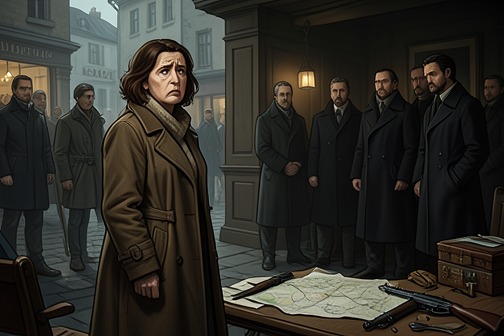
The [First World War](entity:event-recall-event-first-world-war-ddadba2d85b1) stands in Victoria McCandless’s life as both a public catastrophe and a private indictment. She had hoped that workers in [Britain](entity:location-recall-location-cc30c45755f2) and [Germany](entity:location-recall-location-a3c24dd56e42) could stop a declaration of war by striking together; instead, her two youngest sons joined the army and died at the [Battle of the Somme](entity:event-recall-event-battle-of-the-somme-44f76f0aef16), while her eldest supported the war effort from a government office. The contrast between the humane lives she believed her family had prepared for and the choices her sons made turned the war into a question she could not set aside: how had people come to regard their own lives as expendable?
## Before the War
By the years before the conflict, [Glasgow](entity:location-recall-location-glasgow-50d067f692a1) offered Victoria grounds for political hope. The city had developed public resources during its Liberal phase, its skilled workers were described as the best educated in Britain, and the co-operative movement was growing. The municipal telephone system was also being adopted for expansion across the United Kingdom. These changes suggested to her that social improvement could be made through collective action and public provision.
That confidence existed alongside the material competition she feared. Government contracts for warships built along Clydeside answered the construction of German destroyers. The industry brought money and achievement, but its growth depended on preparations for conflict. Victoria took H. G. Wells’s imagined air war, in which a German fleet attacks New York and a worldwide conflict destroys major centres of civilization, as a warning rather than a prediction. Her hope was not that disaster was inevitable, but that people could act to prevent it.
She placed particular faith in organized labour. British and German labour and trade-union leaders had agreed that, if their governments declared war, they would call a general strike. Victoria could even imagine welcoming a declaration if workers then stopped the fighting by peaceful means: such action, she believed, might shift practical and moral power from owners to the people who made society’s necessities. The war would expose how fragile that hope was. The workers did not prevent the conflict, and her own sons did not follow the anti-war course she had expected.
## The War and Its Family Cost
From 1900 onward, Victoria had been active in the suffragette movement. The war of 1914 shocked her profoundly. Her two youngest sons enlisted almost at once and were killed soon afterward at the Battle of the Somme. Their deaths made opposition to the war more than a political position: the appeal to national duty had taken the lives of the children she had expected to become peaceful professional public servants.
The eldest son, Baxter McCandless, took a different role but also entered the machinery of war. Working at the Department of Imperial Statistics, he produced calculations that presented the numbers killed and maimed in [France](entity:location-recall-location-4f282e1af8a7) as less alarming by comparing them with casualties that might have occurred in peacetime accidents. Victoria believed that this reasoning comforted shareholders and profiteers while making the dead easier to forget. In her view, her eldest had contributed his mind where his brothers had contributed their bodies.
Baxter died in 1919, aged twenty-seven, after being struck by a taxi in [Paris](entity:location-recall-location-paris-c02b439ce220) while attending Lloyd George at the Versailles peace conference. His death came after the loss of his brothers and extended the family’s wartime aftermath into the peace negotiations. For Victoria, the distinction between the sons who had served in the trenches and the one who had worked with statistics did not amount to a distinction between victims and non-victims: she came to see all three as caught in a culture that had taught them to disregard themselves.
## The Causes of Obedience
Victoria did not explain the war solely as the product of foolish or murderous individuals. She considered the national and commercial rivalries behind it part of a longer history of conflict, but asked why millions of men, individually neither bloodthirsty nor stupid, had obeyed commands to kill and be killed on such a scale. She drew on Tolstoy’s idea that human beings could become subject to epidemics of insanity, and, as a doctor, treated an epidemic as something whose causes might be found and prevented.
One possible cause was overcrowded living and working conditions, which she thought could make people as susceptible to belligerence as other overcrowded creatures. But the war did not fit that explanation alone: she noted that at least a quarter of those who fought and died were prosperous people with spacious homes, a class that included nearly all those who ordered and officered the slaughter. She therefore came to describe the underlying condition as an epidemic of suicidal obedience, rooted in the belief that one’s life had no value.
The military examination of recruits sharpened this diagnosis. Men queued naked for inspection by a clothed examiner, submitting their bodies to a system that, in Victoria’s account, treated them as insensitive machines controlled by remote authorities. Her image made enlistment and medical inspection more than administrative steps: they were an initiation into a way of thinking in which a person’s body, and ultimately his life, could be handed over to the machinery of killing.
This explanation turned the question back on her own family. She rejected the idea that men were naturally depraved and could not blame their schooling, since the military history taught at school had been countered by what the boys read and learned at home. For their first six or seven years, she reflected, she had had considerable power over them, with money and a loving husband. The boys had grown up in a clean, spacious home with loving, educated, adventurous parents, and had been preparing for humane public work. Yet when war came, all three acted against the values she believed they had been given. She concluded that she had failed to instil the self-respect that might have helped them resist self-abasement.
## Aftermath and Continuing Opposition
The war’s effect persisted in Victoria’s political life. She split with the [Fabian Society](entity:organization-recall-organization-fabian-society-8e3c5fa9ad49) over what she regarded as its insufficient opposition to the killing, and appeared alongside Keir Hardie, Jimmy Maxton, [John Maclean](entity:character-recall-character-john-maclean-820e60c3ebbd), and other Clydeside socialists who opposed the war and advocated Scottish home rule. Her break with the Fabians reflected a widening gulf between cautious tolerance of the conflict and her demand to oppose it directly.
In 1920 she published [A Loving Economy](entity:expression-recall-expression-a-loving-economy-d336d0725419) at her own expense, presenting her search for the roots of national and class warfare. It received no serious attention, despite her sending copies to trade-union branches and people listed in Who’s Who; two thousand copies sent to equivalent recipients in North America were seized and burned by [United States](entity:location-recall-location-5d55e9152db1) customs. The limited reception did not resolve the questions the war had left her with. In a later interview, asked what she regretted, she named the war; when the interviewer clarified that he meant something for which she personally felt responsible, she gave the same answer. The repetition joins public grief to private self-accusation.
After the 1945 general election, Victoria briefly read the newspapers again and welcomed the Labour government’s majority, expected repeal of anti-trade-union laws, social welfare and national health care, public ownership, and the prospect of abandoning the [British Empire](entity:organization-recall-organization-british-empire-1ed378e18a0a). She interpreted the period from 1914 onward as a disastrous departure from social progress. Her response did not erase the losses or her account of her own failure. Instead, the war remained the central rupture against which she measured the possibility of a more humane society: a society in which public provision and collective power might help make lives worth protecting.
Event 8
Battle of the Somme
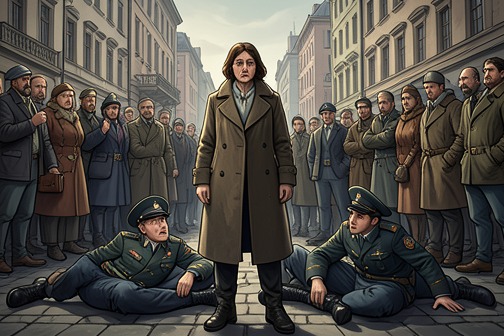
The [Battle of the Somme](entity:event-recall-event-battle-of-the-somme-44f76f0aef16) enters the account of Victoria McCandless not through a description of military action but through its consequence at home: her two youngest sons were killed there after enlisting almost as soon as war began. Their deaths transformed opposition to war from a political conviction into an irreversible family catastrophe.
## The Battle and the Family Loss
The narrative links the Somme to the outbreak of the 1914 war. Victoria McCandless wanted working people and soldiers to stop the conflict by going on strike; her two youngest sons, by contrast, joined the army almost at once. They were killed at the Somme soon afterward. The account gives no battlefield detail, instead marking the battle through the abrupt and intimate fact of their deaths.
The loss is presented as the shock from which Victoria never recovered. The compressed sequence—war, enlistment, deaths—makes the battle a decisive rupture in her life as well as a historical event. The narrative does not specify the sons’ names, military roles, or the circumstances in which they died, and supplies no account of their experience at the front.
## Political Consequences
Victoria’s response to the war was to urge working people and soldiers to end it through a strike. She broke with the [Fabian Society](entity:organization-recall-organization-fabian-society-8e3c5fa9ad49) over what she called its lukewarm tolerance of criminal carnage, and appeared on platforms with Keir Hardie, Jimmy Maxton, [John Maclean](entity:character-recall-character-john-maclean-820e60c3ebbd), and other Clydeside socialists who opposed the war and advocated Scottish home rule. The deaths at the Somme stand beside this public campaigning: they give personal force to her opposition, though the account does not reduce her politics to bereavement alone.
Her conflict with her eldest son, Baxter McCandless, further exposes the divisions the war produced within her family. He supported the war effort from his desk in the Department of Imperial Statistics. In a letter to Patrick Geddes, Victoria accused him of manipulating figures to make the scale of killing and maiming in [France](entity:location-recall-location-4f282e1af8a7) appear less horrifying by comparing it with deaths and injuries that might have occurred in peacetime accidents. She argued that such accounting comforted the beneficiaries of war industry and risked making the dead soldiers as readily forgotten as victims of factory and road accidents.
## Narrative Significance
The Somme is thus recalled as both a site of death and a point of pressure between public argument and private grief. The narrative places Victoria’s campaigning, her break with the Fabian Society, and her estrangement from her eldest son in the same wartime sequence as the deaths of her younger sons. It offers no battle scene; instead, it shows the conflict reverberating through political allegiance, family relationships, and the struggle over how wartime deaths are counted and remembered.
Event 9
Paris Peace Conference
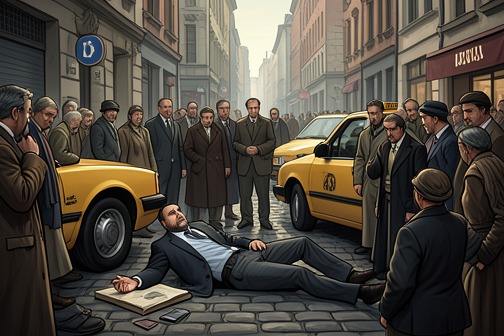
The [Paris Peace Conference](entity:event-recall-event-paris-peace-conference-ce57a160e611) enters the narrative through a family death rather than through its negotiations: Baxter McCandless was attending Lloyd George when a taxi-cab knocked him down in [Paris](entity:location-recall-location-paris-c02b439ce220). His death, at twenty-seven and without issue, makes the conference a sharply personal point of reference in the account of his mother and her family.
## Baxter McCandless at the Conference
Baxter McCandless accompanied Lloyd George to the Paris Peace Conference in 1919. The account offers no description of the conference’s proceedings; it establishes his presence there only to explain the circumstances of his death.
## Death in Paris
While in Paris for the conference, Baxter McCandless was knocked down by a taxi-cab and died at the age of twenty-seven. He died without issue. The abrupt accident places a private bereavement alongside the public gathering, and gives the conference significance in the narrative as the setting of this family loss.
Event 10
Second World War
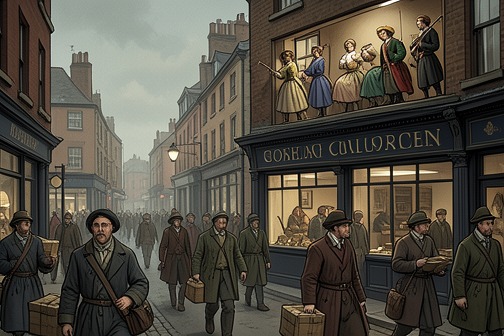
The [Second World War](entity:event-recall-event-second-world-war-ac43861ef4b3) briefly renewed both the industrial and intellectual life of Clydeside. As bombing changed the movement of people within [Britain](entity:location-recall-location-cc30c45755f2), [Glasgow](entity:location-recall-location-glasgow-50d067f692a1)’s wartime importance was expressed not only through its port but also through the cultural activity gathered around [18 Park Circus](entity:location-recall-location-18-park-circus-54e62df6ac3a), which became one of the city’s unofficial arts centres.
## Glasgow and the Wartime Shift
Glasgow served as the principal transit port between Britain and the [United States](entity:location-recall-location-5d55e9152db1). The bombing of southern Britain also inclined many people to move to the northern industrial capital, bringing a wider wartime influx into the city. The account presents these shifts as the setting for a temporary revival of local industry and intellectual life.
## 18 Park Circus as an Arts Centre
The painter J. D. Fergusson returned to Glasgow with his wife, Margaret Morris. They had known Victoria McCandless in her younger days, and Morris rented the upper floor of 18 Park Circus as a rehearsal space for her Celtic Ballet Company. Until 1945, the house was one of several small, unofficial arts centres flourishing on or near Sauchiehall Street.
Painters Robert Colquhoun, Stanley Spencer, and Jankel Adler lodged at or visited the house. The poets Hamish Henderson, Sidney Graham, and Christopher Murray Grieve, better known as Hugh MacDiarmid, also came there. Their presence places the house within a wartime cultural network that brought together rehearsal, visual art, and poetry in a domestic setting.
## A Temporary Cultural Convergence
The account marks the arts-centre period as lasting until 1945, linking its end to the wartime interval rather than presenting it as a permanent institution. In his 1966 autobiography, Hugh MacDiarmid recalled the basement landlady as an exceptional Scottish healer and remembered her pets’ hospital and generously served Scotch broth. That recollection adds a vivid personal dimension to the house’s role: it was not simply a venue, but also a home whose everyday life intersected with the artists and writers who gathered there.
Event 11
1945 United Kingdom general election
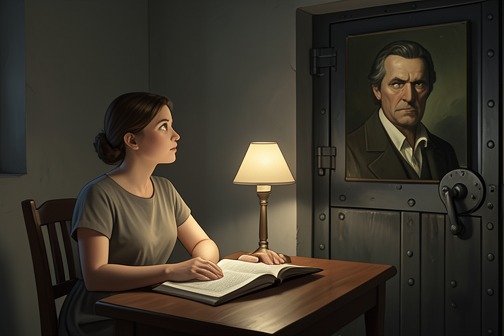
The [1945 United Kingdom general election](entity:event-recall-event-1945-united-kingdom-gen-c49f24f684c5) becomes, for Victoria McCandless ([Bella Baxter](entity:character-recall-character-bella-baxter-25aa9cac7b59)), a sudden opening onto a better political future. In a letter written soon after the result and shortly before her death, Labour’s overall working majority makes [Britain](entity:location-recall-location-cc30c45755f2) feel newly alive with possibility; her hope is so complete that she says she is going to die happy.
## The result as a turning point
The letter is undated, but its editor places it soon after the election. Victoria welcomes the arrival of a Labour government with an overall working majority as a historic change, and says she will begin reading the newspapers again. The result shifts her attention from political disappointment toward the prospect of reform: Britain, she writes, has suddenly become exciting.
Her response is not merely approval of an electoral victory. She reads the result as evidence that the country may resume a path of social progress interrupted by the upheavals since 1914. The election therefore marks a personal reversal as well as a change in government: political hope, apparently dormant, returns with force.
## The programme she anticipates
Victoria expects the new government to repeal the anti-trade-union laws of 1927 and establish social welfare and national health care for all. She also foresees Fuel and Power, Transport, Iron and Steel becoming public property, placing essential services and major industries under collective ownership. Her vision extends beyond domestic policy: she expects Britain to abandon the [British Empire](entity:organization-recall-organization-british-empire-1ed378e18a0a), which she regards as a burden.
She measures this anticipated settlement against the Soviet Union, believing that Britain is setting the world a finer example. The letter presents the election not as proof that the promised changes have already occurred, but as the political opening through which she expects them to become possible. Its repeated confidence in what the country will achieve gives her hope the character of a forecast, not a report of completed reforms.
## A revised history and a final hope
Victoria identifies the Lloyd George budget as the last fixed point on the sound path of social progress. In her account, the old-age pension had abolished poor-houses, while death duties had begun to break up the enormous estates. She regards the period from 1914 to the present as a hideous detour away from that reforming course, and the election as a chance to return to it.
The result also unsettles her earlier political expectation. She acknowledges that [John Maclean](entity:character-recall-character-john-maclean-820e60c3ebbd) was wrong: a workers’ co-operative nation may be created from [London](entity:location-recall-location-london-420923d4a60a), without an independent [Scotland](entity:location-recall-location-scotland-4e112aa71aa3) first showing the way. This is a substantial adjustment to her view of national change, even as she remains certain that her correspondent will reject her optimism and point to the forces undermining Britain. The letter ends not with an answer to those doubts, but with Victoria’s insistence that she will die happy. The election’s lasting significance in this episode lies in that final conviction: for a short time, the prospect of collective reform outweighs her awareness of political danger.
Event 12
People's Budget
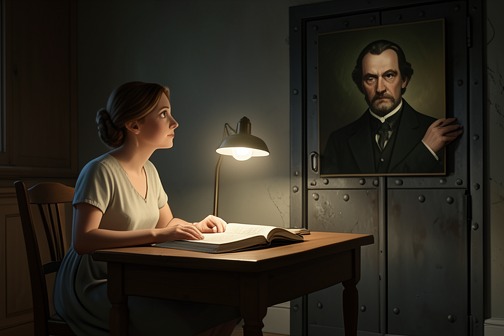
The [People's Budget](entity:event-recall-event-people-s-budget-0d2879abb3b2) is remembered in [Poor Things](entity:expression-recall-expression-poor-things-43fe79b731a0) as a landmark of social progress whose reforms Victoria McCandless later treats as a turning point [Britain](entity:location-recall-location-cc30c45755f2) failed to build upon. Its place in the narrative is less that of a staged political event than of a measure recalled in a letter, where its social consequences become a standard against which later history is judged.
## Reforms and Social Consequences
In a letter written after the election of a Labour government, Victoria looks back on what she calls the Lloyd George budget. She credits it with abolishing poor-houses through the old-age pension and beginning to break up enormous estates through death duties. The account links public provision for older people with a challenge to concentrated landed wealth: reform appears not as a single isolated benefit, but as a change in how society distributes security and property.
## A Political Turning Point in Retrospect
Victoria identifies the budget as the last fixed point on the good path of social progress before the upheavals beginning in 1914. Her description makes the budget a measure of what later politics might have continued, rather than merely a past legislative achievement. In the letter’s hopeful present, she imagines social welfare and national services becoming public, and the [British Empire](entity:organization-recall-organization-british-empire-1ed378e18a0a) being abandoned; against those expectations, the earlier budget represents a precedent for structural change.
## Narrative Significance
The event reaches the reader through Victoria’s retrospective letter, not through a direct account of parliamentary debate or the budget’s passage. That framing emphasizes political memory: the budget matters because of what Victoria believes it made possible and because she uses it to interpret the decades that followed. Her confident hope in a new Labour government also gives the recollection an unsettled edge. The measure stands both as evidence of reforms already won and as a point of comparison for a future she believes may yet resume the interrupted course of social progress.
Event 13
Ashanti rebellion
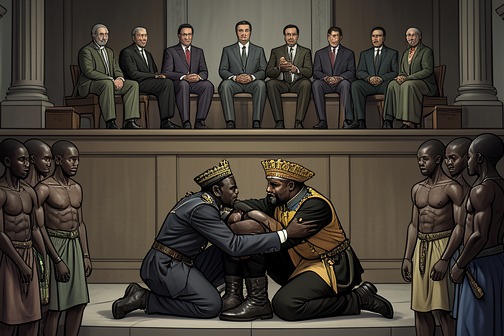
The [Ashanti rebellion](entity:event-recall-event-ashanti-rebellion-9f496be5c851) is recalled through a colonial demand that made King Prempeh’s submission a public ritual. The account’s striking detail is not a battle but the encounter on a platform: the King and Queen Mother kneel before British officials and embrace their legs and booted feet, while Ashantis watch their ruler’s abasement.
## Demand and Setting
After the Ashanti rebellion, one of the Governor’s demands was that King Prempeh make abject submission according to native custom. The account identifies the requirement as an imposed act of humiliation, setting the terms for a scene in which the conquered ruler must enact his defeat before witnesses.
## The Act of Submission
King Prempeh removed his crown and sandals and came forward with the Queen Mother. They reached the platform where Sir Francis Scott, General Blessington, and Mr Maxwell were seated, then knelt and embraced the Englishmen’s legs and booted feet. The Ashantis looked on as their King performed the abasement demanded of him.
## Colonial Spectacle
The scene places the ruler’s removed crown and sandals beside the officials’ elevated position on the platform. Submission is presented not only as a demand made after rebellion but as a visible performance before the Ashantis. General Blessington’s presence among the seated officials connects him to this display of colonial authority; the account makes the King’s humiliation, and the watching audience’s astonishment, its defining image.
Event 14
Burmese expedition to Mandalay
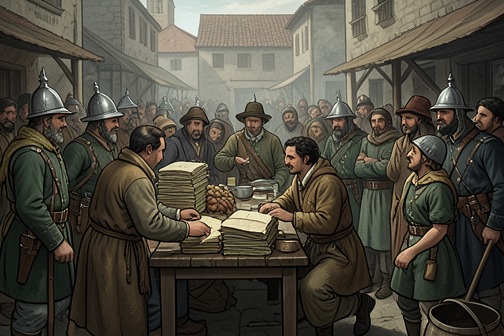
The [Burmese expedition to Mandalay](entity:event-recall-event-burmese-expedition-to-m-36c5538c9453) is represented through its aftermath as well as its military purpose: loot is shown being auctioned in Mandalay, while [General Sir Aubrey de la Pole Blessington](entity:character-recall-character-general-sir-aubrey-a1b9077b9d4b) is credited with defending extra rewards for soldiers who preserve the Empire’s peace. The account links imperial service to the distribution of captured wealth, presenting material reward as an obligation owed to the common soldier.
## The Auction in Mandalay
The expedition’s aftermath is identified with the auctioning of loot in Mandalay. The evidence supplies no inventory, prices, or account of who bought the goods; its emphasis is instead on the auction as a visible consequence of the campaign. Military success thus appears not only as an assertion of imperial power but also as a transfer of possessions into a market.
## Blessington’s Argument for Reward
In connection with the auction, General Sir Aubrey de la Pole Blessington is described as believing that the common soldier who preserves the Empire’s peace deserves more than ordinary wages. The claim presents additional reward as due recognition for imperial service. Read beside the auction of loot, it brings the material fruits of conquest into the same frame as the soldier’s compensation, while the account gives no further detail about how the proceeds were allocated.
Event 15
Lushai punitive expedition
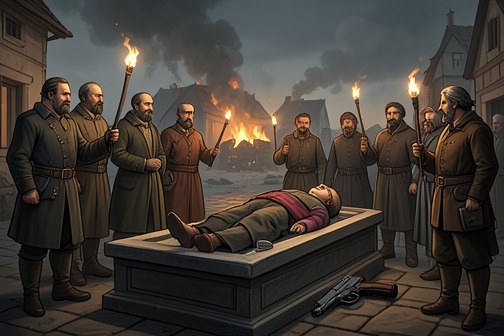
The [Lushai punitive expedition](entity:event-recall-event-lushai-punitive-expedit-c4db6333422d) appears in a newspaper-style account that turns the discovery of a dead officer’s gun into an argument for the burning of Lushai homes. The episode’s significance lies not only in the alleged evidence against Chief Howsata, but in how the report presents that evidence as vindication of [General Sir Aubrey de la Pole Blessington](entity:character-recall-character-general-sir-aubrey-a1b9077b9d4b)’s punitive actions.
## Background and Report
The account concerns a punitive expedition against the Lushai Hill tribes and the death of Lieutenant Stewart. It says that reports from other villages had proposed a test of the accusation against Chief Howsata: if Howsata had murdered Stewart, Stewart’s gun would be found in the chief’s grave. The expedition opened the grave to examine that claim.
## The Discovery and Its Interpretation
According to the report, Howsata’s embalmed body lay in the grave with Stewart’s gun beside it. The article presents this discovery as conclusive proof that Howsata had murdered Stewart. It then extends that conclusion to Blessington’s conduct, declaring him justified in burning the homes of the guilty tribesmen. The report thus moves from a specific object found in a grave to an endorsement of collective punitive destruction; its certainty belongs to the account’s framing, rather than to any independent evidence supplied here.
## Narrative and Significance
The episode is preserved among accounts of Blessington’s career as reported in the Graphic Illustrated Weekly News. Its documentary form makes the discovery appear to settle the accusation, while the report’s own logic links an individual’s alleged murder to the burning of homes. The surviving passage records that justification, but supplies no further account of the expedition, the people whose homes were burned, or what followed.